
About the Author
Devorah Goldman is a contributing editor at Mosaic and other publications and a visiting fellow at the Ethics and Public Policy Center. She writes frequently on medicine.

May 26, 2026
The modern world claims mastery of medicine and nature, while stripping us of an essence known since our first days in Eden.
Then the Man said,
This one at last
Is bone of my bone
And flesh of my flesh.
Genesis 2:23
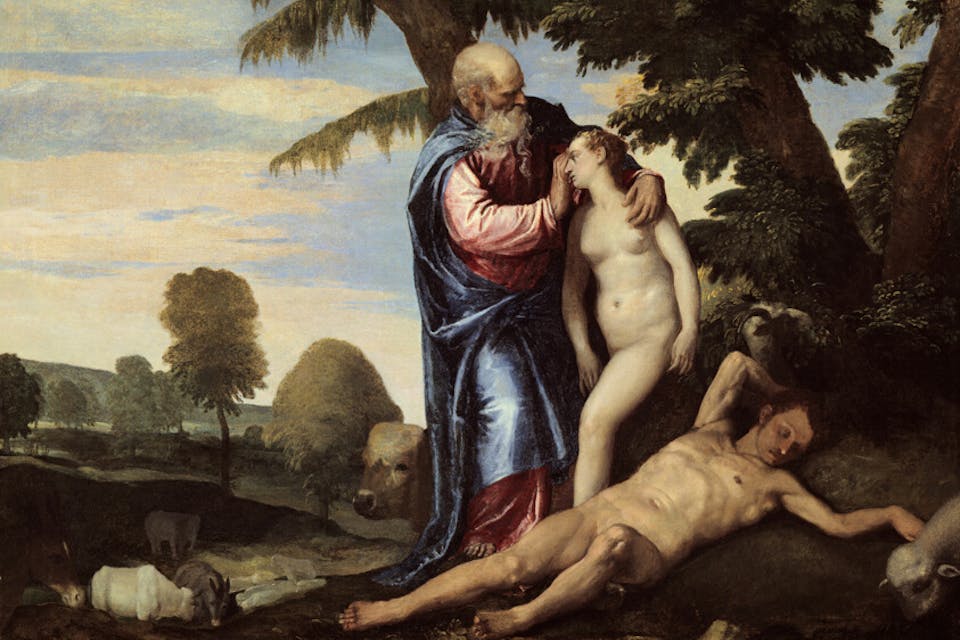
History’s first surgery seems to occur in the second chapter of Genesis, performed by God Himself. The technical and gritty procedure begins as God “cast a deep sleep upon the Man.” The biblical term for this sleep—tardemah—refers to anesthesia in modern Hebrew. The operation continues in a surprisingly clinical manner: God takes Adam’s rib, “closes the flesh at that site,” and “builds” his companion. The episode concludes with an earthy proclamation: woman is “bone” and “flesh” of Adam himself.
Then the Man said,
This one at last
Is bone of my bone
And flesh of my flesh.
Genesis 2:23
History’s first surgery seems to occur in the second chapter of Genesis, performed by God Himself. The technical and gritty procedure begins as God “cast a deep sleep upon the Man.” The biblical term for this sleep—tardemah—refers to anesthesia in modern Hebrew. The operation continues in a surprisingly clinical manner: God takes Adam’s rib, “closes the flesh at that site,” and “builds” his companion. The episode concludes with an earthy proclamation: woman is “bone” and “flesh” of Adam himself.
Questions rush in. Why surgery? Why was Eve crafted in a seemingly mechanical manner? Much of the biblical account of creation lies beyond mortal imagining—Adam was formed from the earth and breathed into life by God’s breath. This induced sleep, followed by the opening and stitching up of a body, is different. Adam receives Eve with relief but no nod to the sublime or mention of the image of God; he describes her arrival in material terms.
The details of this account lend themselves to a larger inquiry that will guide this column. What is a human person? What is the significance of being composed of tissue and ligament? What do we recognize in one another when, as Adam did, we feel relief at encountering material man, away from screens or the realm of thought, in what we understand as “real life?”
And there is another element: in fashioning Eve, God served as Adam’s diagnostician and healer. He identified Adam’s solitude as an infirmity demanding costly physical correction. But Eve was not an antidote meant to restore Adam to what he had once been; his afflicted spirit was inherent to his original condition. Before the sin or the expulsion, Adam was formed in a state of privation, an alienation that persisted despite God’s presence. Diagnosis, repair, and healing were woven into creation.
This yields more questions. How ought we to understand the human healer, who serves as an authority of the body and mind? What is the physician’s responsibility in observing his patients’ most private or frightful sufferings?
These questions are difficult to answer simply, in part because the practice of medicine, a product of Western science, is at once triumphant and confused. Ethical debates trail the adoption of breathtaking and fearsome technologies. The digital world swiftly forges and severs human attachment and obligation—including among doctors and patients. Physicians bear the weight of legal and moral responsibility for patient welfare but are increasingly alienated from their profession as it was once understood.
Western medicine has drifted very far from early iterations of the Hippocratic Oath, with its simple dictate against doing no harm. Many or perhaps most medical schools write their own versions now, often stripping the clauses against euthanasia or abortion; the notion of an immovable and foundational set of ethics guiding the profession seems anachronistic. Rather than being considered moral and scientific authorities, doctors are now commonly referred to as “providers” of a product known as “healthcare,” demanded by “consumers.” A combination of bureaucratic and economic pressures has pushed most American doctors out of small private practices, which entail more immediate accountability to individual patients, and into large corporate or academic facilities—in which patients are too often treated as data and doctors as data-entry clerks.
Meanwhile, the problem of alienation sketched in Genesis remains. We see glimpses of it in ceaseless efforts at transcendence via a kind of material rebirth, under the surgeon’s knife or through pharmacology. These efforts lie at one end of a spectrum in today’s technological landscape. At the other end are applied sciences that seek to sever the bond between matter and mind altogether, to create or discover a form of human personhood without human flesh. The National Institutes of Health recently completed the Human Connectome Project, a ten-year effort to build a “network map” of a healthy brain. Ambitious researchers now seek to “upload” the mind’s map to a kind of online cloud, an effort to preserve “digital consciousness.” In a bid for eternal life, the tech entrepreneur Sam Altman paid to join a waitlist of 25 people at Nectome—a startup that promises to store minds on computers.
We may have made a start in this direction through Elon Musk’s company Neuralink, which produces “generalized brain interfaces”—implantable chips that have helped people with ALS or spinal-cord injuries “translate” their thoughts into AI-generated speech. The chips have also enabled paralyzed individuals to operate robotic arms with instructions issued from their minds. An upcoming trial aims to help the blind “see” without the use of their eyes. We are living in the future, or on its razor’s edge. Scientific triumphs like those promised by Neuralink offer deliverance alongside a capacity for chilling corruption.
The role of medicine also lies at the heart of ferocious arguments over, for example, whether eugenics should be permitted to inform the practice of embryo selection in common fertility treatments, and whether doing so has more in common with Nazi visions of biological fitness than with medicine properly understood. The field of genetic-editing research, which entails experimenting upon and discarding embryos, is similarly embattled. Legal fights over custody, fraud, and constitutionality have followed the increasingly common practice of surrogate pregnancy, paid or unpaid. We have just begun discussing “grief tech,” the use of artificial intelligence to produce digital avatars of the deceased in films or facsimiles of FaceTime-style “conversations.” Technologies abound relating to the emancipation from all material necessity, including the need to contend with death. The tech marches on, qualms be damned.
It is beyond the scope of this essay to examine these challenges in detail, though we will revisit many in future columns. But let us return to the moment when Adam sees Eve; why does he immediately acknowledge her as etzem? Usually translated as “bone,” etzem is a protean term evoking ideas of essence or self. The phrase etzem hayom marks events that occur in the heart of a fraught day: when Noah enters the Ark, when Abraham circumcises his household, or when the Israelites leave Egypt. It captures something elemental about such moments. Maimonides notes that the etzem of the Day of Atonement itself atones. Etzem continues to be a pliant word in modern Hebrew; Yom Ha-Atzma’ut, Israel’s Independence Day, might be literally translated as “Day of Selfhood.” The term is also related to otzmah, strength or power.
Westerners frequently associate selfhood with agency or autonomy or individual fulfilment. An ideal of self-expression fuels movements like transhumanism. But the term for self is introduced in the Bible in the context of two highly vulnerable people who cannot do without one other. Eve, though formed by God, is utterly human, of flesh and bone. Before they are exiled from Eden and condemned to labor for their bread and in childbearing, Adam and Eve are acknowledged as being composed of matter and recognize one other as such. Adam’s corporeal transformation, yielding a new corporeal being, was integral to creation itself.
The account of the human person in Genesis thus stands in tension with much of modern medicine. Medical corporations tend to see patients as data serving the cause of future medical breakthroughs and doctors as administrative cogs. In their own way, tech entrepreneurs present people as abstractions and corporeality as incidental; a person might operate just as well uploaded to a digital cloud or preserved in AI form or nudged along with the help of an AI companion.
Genesis counters all this by presenting an original Healer who recognizes in the patient an individual person constituted by need, by incompleteness, who is social and who requires the ministrations of other material persons. A bone is useless without other connective bones; a human self requires other selves, in the flesh. The biblical account, then, is the starting point for Etzem, a column that will consider the human person through a biblical frame, as a self that is unfinished, in need of healing of the body and mind, in need of the other. It will examine questions of the future of medicine, of technology and invention, while acknowledging the problems of human loneliness and the facts of human substance.
"Etzem" is generously sponsored by Dr. Sheldon Rubenfeld and dedicated to a bright and ethical future for medicine.
Part of:
Medicine, bioethics, technology, and what it means to be created in the image of God.

Devorah Goldman is a contributing editor at Mosaic and other publications and a visiting fellow at the Ethics and Public Policy Center. She writes frequently on medicine.
Unlock the most serious Jewish, Zionist, and American thinking.
Subscribe Now